
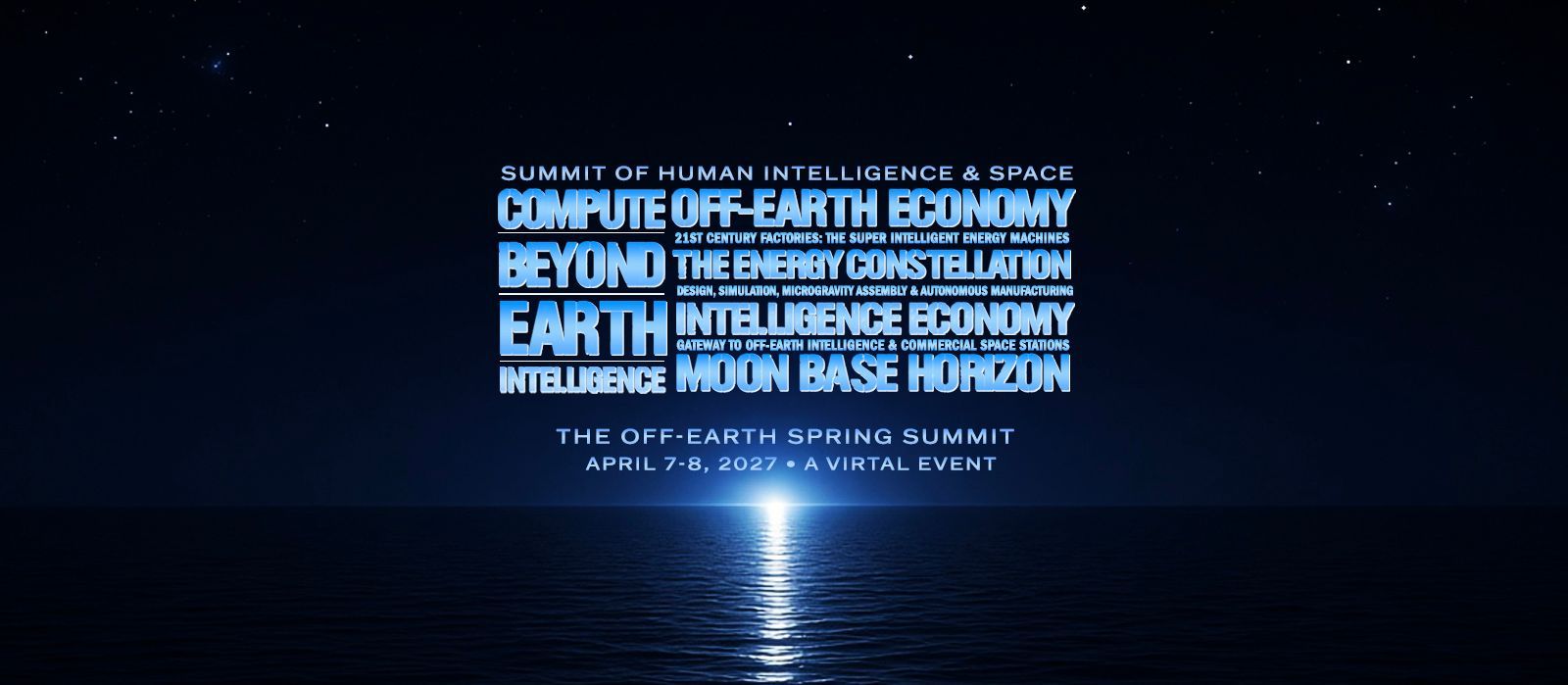

A Virtual Event for Leadership in the Off-Earth Economy
Wednesday, April 7th -Thursday, April 8th - All Registration is Complimentary

The Off-Earth Economy: The Four Themes
• The Energy Constellation: Powering Earth, the Moon & Beyond
• The Planetary Bandwidth Canopy: Orbital Communications & Distributed Intelligence
• The Intelligence Factories & Science: Infrastructure, Autonomous Machines, Manufacturing & Assembly
• The Lunar Habitat: A Vision for the First Sustainable Off-Earth Colony


The Evening Keynote Roundtables

The next great industrial revolution may not take place entirely on Earth. A new generation of energy systems, intelligent satellite networks, advanced computing infrastructure, and autonomous technologies is creating the foundation for an Off-Earth Economy. From solar energy constellations and orbital communications to the intelligent infrastructure supporting lunar exploration, the possibilities are extraordinary. What technologies will power this emerging industrial frontier? How will energy innovators, hyperscalers, telecommunications companies, aerospace leaders, and financial institutions collaborate to build the next generation of planetary infrastructure? And how will the convergence of energy, intelligence, and communications transform the economics of life and industry beyond Earth?

The Moon is becoming the destination for one of humanity's most ambitious scientific and engineering undertakings. Reaching its surface is only the beginning. Establishing a sustainable human presence will require extraordinary advances in transportation, autonomous construction, energy generation, communications, robotics, and life-support technologies. From lunar landing systems and intelligent exploration vehicles to the first permanent habitats, an entirely new architecture of human activity must be imagined and built. What breakthroughs will make the next generation of lunar missions possible? Who will develop the infrastructure necessary for sustained exploration? And how will the scientific and industrial achievements of the coming years lay the foundations for a new chapter in human civilization?

A new scientific renaissance is emerging at the intersection of human intelligence, artificial intelligence, advanced materials, robotics, physics, and space exploration. Technologies once confined to research laboratories are opening extraordinary possibilities for discovery and experimentation beyond Earth's atmosphere. Microgravity research, autonomous scientific instruments, intelligent observatories, and new approaches to materials science may transform our understanding of the physical universe while generating breakthroughs with profound applications on Earth. What happens when scientists gain access to entirely new environments for experimentation? How will Super Intelligence accelerate the process of discovery? And what new frontiers of knowledge will emerge as humanity extends its scientific imagination beyond the boundaries of our planet?

Imagine an industrial infrastructure powered by solar energy, directed by Super Intelligence, and operated by autonomous machines across orbital platforms and lunar environments. The convergence of advanced robotics, intelligent manufacturing, energy systems, and machine reasoning is creating the technological foundation for factories capable of operating far beyond traditional terrestrial industrial networks. These emerging systems may construct infrastructure, process materials, maintain equipment, and coordinate complex operations with unprecedented levels of autonomy. What will the first generation of Solar Intelligence Factories look like? How will intelligent machines collaborate across enormous distances? And what advances in energy, robotics, and industrial design will transform autonomous space infrastructure from scientific possibility into economic reality?

A new architecture of planetary intelligence is emerging above the Earth. Thousands of interconnected satellites, advanced communications networks, orbital computing systems, and increasingly autonomous technologies are transforming the relationship between space and terrestrial infrastructure. Imagine a global intelligence network capable of observing environmental change, coordinating communications, processing information, and supporting scientific and industrial activity across Earth and beyond. How will the convergence of satellite constellations, cloud computing, artificial intelligence, and next-generation telecommunications reshape the infrastructure of the digital economy? What happens when computing and communications become increasingly distributed between terrestrial and orbital systems? And how might the Satellite Umbrella become an essential foundation for the emerging Off-Earth Economy?

Manufacturing is preparing to cross one of its most extraordinary frontiers: the boundary between Earth and space. Microgravity environments, autonomous robotics, advanced materials, additive manufacturing, and intelligent production systems are opening new possibilities for scientific experimentation and industrial development. From specialized materials and pharmaceutical research to robotic assembly, orbital fabrication, and the eventual construction of lunar infrastructure, the technologies of Off-Earth manufacturing are beginning to take shape. Which products and processes might benefit from production beyond Earth's atmosphere? How will autonomous machines manufacture, assemble, inspect, and maintain complex systems in space? And what combination of scientific breakthroughs, commercial investment, and industrial innovation will turn orbital manufacturing from experimental achievement into a sustainable economic enterprise?

Humanity's exploration of space has always been an exploration of human imagination. Now, as artificial intelligence, cognitive science, neuroscience, immersive simulation, and advanced computing converge, entirely new questions are emerging about the relationship between human creativity and the universe we seek to understand. How will living and working beyond Earth transform human perception, collaboration, learning, and invention? What happens when scientists, artists, engineers, philosophers, and intelligent machines begin exploring the same frontier together? Can the extraordinary environments of space inspire new forms of creativity, scientific reasoning, and cultural expression? And as Super Intelligence becomes an increasingly powerful partner in discovery, how might the exploration of space change not only what humanity knows, but what humanity is capable of imagining?

The power to simulate increasingly complex physical, biological, and intelligent systems introduces extraordinary scientific opportunities—and profound questions of responsibility. As artificial intelligence accelerates discovery, researchers are developing computational models capable of exploring molecular structures, engineering systems, planetary environments, and increasingly sophisticated autonomous behaviors. But what happens when simulation begins to influence decisions whose consequences cannot be fully anticipated? Who establishes the boundaries of experimentation when intelligent models become essential instruments of scientific discovery? How do researchers distinguish prediction from understanding, and technological possibility from responsible application? From the laboratory to the emerging Off-Earth frontier, this roundtable explores the ethical, scientific, and human challenges of an age in which the power to model reality may increasingly shape reality itself.

Contact Us
Thank you for contacting us.
