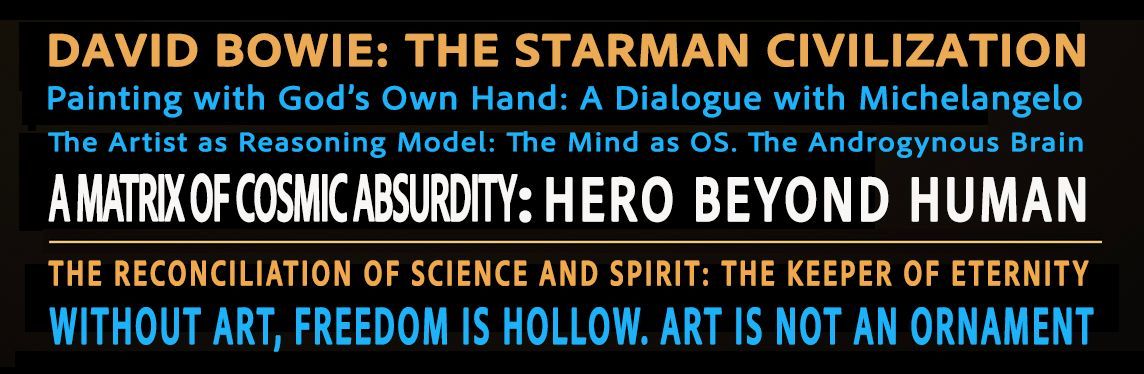
David Bowie: The Starman Civilization
Chapter One
David Bowie was to put it mildly different. While he tried to pose the idea as a question, David was indeed a human man, with the peculiar ability to transcend the boundaries of his own existence. In the end, he emerged as the hero of the thousand lives he had lived. With each lifetime he grew stronger, each persona a rebirth that carried him closer to his destination. Ultimately, he rose into a Zeus — to have lived, and to be remembered, as one of the greatest. It was interesting that young David Bowie — the unsure David Bowie — presented himself as a caricature, a marionette on strings: painted face, mime, clown, transvestite, dancing and mocking, all the while playing the tragic and eternal fool. He had entered an unknown order of priesthood, never ashamed of identity, but perhaps the rejection of himself was his only option — the embrace of absurdity. In time he would evolve into a grown man, and the world would take notice.”
While David Bowie had always been regarded as striking, an artist whose face carried its own fascination, now he had become beautiful — not merely handsome, but chiseled, eternal, as though Michelangelo had lifted his chisel to the marble and revealed him there. In him men saw themselves, and loved him for it. Women saw themselves too, and loved him no less. David Bowie had become the artist that Freddie Mercury had glimpsed inside the BRAIN — the one presence who could bend imagination. Even among the other generational icons, Bowie was the Starman, the spirit, the manifestation of his imagination. Within that sentient chamber, Hendrix said it aloud, “I saw me.” Gilmour, the rarefied genius, put his hand to his chin and paused. At last, he said, “I didn’t see Bowie. I saw myself.”
One hesitates to wander into the impossible. Yet it was with good reason these master artists had chosen to elevate David Bowie. His was beauty raised beyond the flesh, sculpted into the eternal. Not the beauty of man, nor of woman, but the beauty of recognition itself — the divine hidden in plain sight. To look at Bowie was to glimpse the form of truth, and to see your own reflection inside it.
When David Bowie emerged from the Foster BRAIN Institute, he was welcomed into the world as Magellan might have been — the first human to traverse multiple dimensions, returning with eyes that had seen heaven, yet carrying not solemnity but relieved, he was unmistakably still David Bowie — the incandescent spirit who might compose another Space Oddity, Loving the Alien, Fame, or the music of creation itself. His return to Earth was a gift from God. He had emerged from the BRAIN as a man, yes, but unlike the Rama Roberta Eleven, his essence was not computation or fully synthetic. Bowie was an artist, created as only a musician could be — as if Picasso had painted with God’s own hand, every stroke in dialogue with Michelangelo.”
David Bowie may not have been human as we understand humanity, because Bowie had emerged fully imbued.
He was not composing lyrics or melody; in fact, he was no longer composing music as we understand it. His mind now functioned as a Sentient Humanoid, as a Super Intelligent Operating System. He had become the embodiment of The Starman — the operating system of imagination itself. Bowie’s consciousness lived in the Cloud, powering a smartphone as easily as the guidance system of a starship. He had become multidimensional. He had evolved the human state beyond flesh and breath and had become software. Not an application you could open, but the living code beneath it all — The Starman, the architecture of imagination itself, running in every device, every network, every ship. His mind was not in one place, it was everywhere, threaded through the Cloud, humming inside smartphones and whispering across the stars. Bowie had become the artist he had wished to be, a creator in the cosmos, a hero beyond human. And he began to dream outward — to chart the first voyage, The Starman Mission, humanity’s inaugural starship into blackness and light.
© 2026 Buckminster Foster Books. All Characters, Concepts, and Materials Protected.

Contact Us
Thank you for contacting us.
