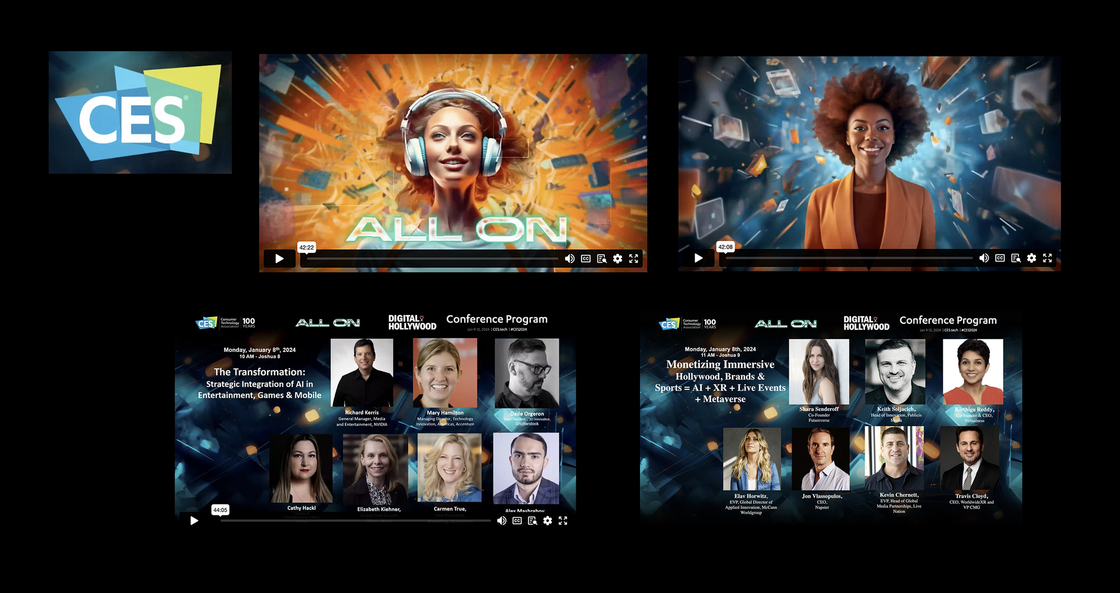
Click on the Video Below and Sample a Session from the last Digital Hollywood event.
For Additional Video Sessions, Click Here



CES 2007, Las Vegas Convention Center, North Hall
Sunday, January 7th
1:00 PM – 2:00 PM
Track II- GP6
Game Power on the Inside: Chips, Optical Technology and Microprocessors
The fact that the power of an enterprise computing system is now built into every game playing machine, with all of its technology dedicated specifically to the game playing experience goes along way to explaining why games are revolutionizing the future of entertainment. The combination of chips, microprocessors, optical technology and storage together with nearly unlimited R&D investment is rapidly leading to a next generation entertainment experience. Games are great today, but what will they look like in two or three years? In this session, we will hear from the technology companies that provide the developers and consumers with game power. They are the developers of the secret sauce that is establishing games as the future of entertainment.
Chris Donahue, Group Manager, Windows Graphics & Gaming Technologies, Microsoft Corp.
Adam Lake, 3D Graphics and Gaming Research, Intel Global Developer Relations Division (GDRD)
Roy Taylor, Vice President of Developer Relations, NVIDIA
Ian McNaughton, Senior Product Manager, Athlon™ 64 FX Processor line, AMD
Michael Dimelow, Director of Marketing for Embedded Software Division, ARM
Richard Kerslake, Worldwide General Manager, 3G and OMAP Business, Wireless Terminals Business Unit, Semiconductor Group, Texas Instruments
Debby Hindus, Vice President of Strategic Alliances and Founder, Rapport, Inc.
Donald A. Jasko, Chief Executive Officer, Digital Economics, Moderator

Chris Donahue,
Director, Windows Graphics & Gaming Technologies, Microsoft: As director for the Windows gaming and graphics team, Donahue leads a team accountable for promoting DirectX and Windows as a premier gaming platform. Donahue and his team are charged with providing game developers, publishers and IHVs with the information, tools and assistance they need to create gaming and entertainment content on the Windows platform. Donahue joined Microsoft in January 2003 as technical evangelist for hardware and was promoted to lead technical evangelist of developer relations. Previously, he was the manager of developer relations at NVIDIA Corporation.


Adam Lake is a Sr. Software Engineer in the Software Solutions Group leading The Modern Game Technologies Project at Intel. Adam has held a number of positions during his 7 years at Intel, including research in non-photorealistic rendering and delivering the shockwave3D engine. He has designed a stream programming architecture, including the design and implementation of simulators, assemblers, compilers, and programming models. Previous to working at Intel, he obtained a MS in computer graphics at UNC-Chapel Hill and worked in the Computational Science methods group at Los Alamos National Laboratory. More information is available at <www.cs.unc.edu/~lake/vitae.html>www.cs.unc.edu/~lake/vitae.html. He has 30 patents filed or pending in the areas of computer graphics and computer architecture, has several publications in computer graphics, and has reviewed papers for SIGGRAPH, IEEE, and several book chapters on computer graphics. In his spare time he is a mountain biker, road cyclist, hiker, camper, avid reader, snowboarder, and Sunday driver.

Roy Taylor, VP Content Relations, NVIDIA: Roy Taylor joined NVIDIA in February 2000 as Vice President of Sales for Europe, Middle East, Africa and India (EMEAI). In 2005 Mr. Taylor relocated to California to work out of NVIDIA’s head quarters in Santa Clara. In his current role, Roy is Vice President of Content Relations and is responsible for the development and support of third party PC software as well as NVIDIA support tools and publication. Prior to joining NVIDIA, Mr. Taylor spent over eight years running his own business as a manufacturers’ representative for IBM Microelectronics and NEC Semiconductors, amongst others. Prior to that, he held various management positions at electronics and component companies. Mr. Taylor holds a Diploma in Business Studies from Mid Kent College of High Education in Maidstone, Kent, United Kingdom.


Ian McNaughton, Senior Product Manager – AMD Athlon™ 64 FX Processor line: Ian joined AMD in 2006 as Senior Product Manager for the AMD Athlon 64™ FX processor line. Previously Ian held Senior Marketing and Product Management roles with such companies as ATI and Mitel Corporation. While at ATI Technologies, Ian managed multiple complex product launches as well as ATI’s HL2 GTM program. Working closely with the developer community has enabled Ian to foster key industry relationships that he continues to enjoy today at AMD. While at Mitel Corporation, Ian was responsible for Corporate Marketing which included a worldwide corporate re-brand in over 20 countries. Mitel now exists as Zarlink Semiconductor. Born in Ontario, Canada, Ian currently resides in Austin, Texas with his family. He is passionate about technology and especially the gaming industry. Well known throughout the hardware and software community, Ian is widely considered a legitimate expert in the computer and gaming fields. Whether it is console or PC, the platform doesn’t matter; Ian is dedicated to evangelizing enthusiast products.

Richard Kerslake, Worldwide General Manager, 3G and OMAP Business, Wireless Terminals Business Unit, Semiconductor Group, Texas Instruments: Richard Kerslake is worldwide general manager for TI’s 3G and OMAP processors business unit. In this position, he manages roadmap development, product design and marketing, and business development and customer support for TI’s 3G business and OMAP processors business. TI’s OMAP platform is estimated to hold two-thirds of the rapidly-growing market for wireless application processors (Source: IDC). Prior to this role, Kerslake was responsible for establishing the company’s system-level integration ASIC business. While in this position, he defined and drove TI’s processor-based ASIC product capabilities and business strategy across a broad range of markets. Before moving to Dallas in 1998, Kerslake worked as the European marketing manager for TI’s ASIC operation, focusing on broadband, networking and wireless applications. He also served as TI’s design and marketing manager for the UK-based digital consumer products group. In this role, Kerslake developed chipsets for consumer audio and video applications, and marketed mixed-signal custom and catalog products. He started his career with TI as an analog IC designer in 1984. Kerslake graduated with a bachelor’s degree in physics and electronics from The University of Manchester in Manchester, England.

Michael Dimelow – Director of Marketing for ARM, embedded software division (ESD): As Director of Marketing for ESD at ARM, Michael is responsible for defining software product strategy, roadmap and market propositioning. His remit is to generate operator awareness and OEM demand for ARM software products, which include TrustZone® (security foundation), IEM™ (Intelligent Energy Management), Jazelle® (Java acceleration) and Swerve (3D graphics engine). Michael has over 13 years experience at the heart of the telecommunications industry, having worked for Nokia, Ericsson, T-mobile, Your Communications, TTPCom before moving to ARM. During this time he has held a variety of business management, marketing and engineering roles that have allowed him to help shape the commercial and technical focus of operators, infrastructure and device manufacturers. Michael holds Michael holds an MSc in Electronic Engineering from Surrey University and an MBA from Manchester Business School.


Donald A. Jasko, Chief Executive Officer of Digital Economics, is an attorney by training. But he has, for the past twenty years, focused his energies on the economic, technological and rights management issues involved in the licensing of copyrighted content. From 1981 through 1997 Don served in various management positions at the American Society of Composers, Authors and Publishers (ASCAP), in which he was instrumental in transforming the process by which performance rights in musical compositions are licensed for television broadcast. He was a key participant in the complex music industry negotiations which culminated in the new "per program" license, as well as the development of the process by which music performance and pricing data are exchanged electronically between performing rights organizations and television broadcasters. Don was also instrumental in the development of the infrastructure that supports the direct and source licensing of performance rights in musical compositions. He testified in a number of legal trials, including the "Buffalo Broadcasting" rate proceeding in Federal District Court for the Southern District of New York. He also represented ASCAP on panels at numerous national conferences. In 1997 Don resigned from ASCAP to found the content management consultancy that is now Digital Economics. As Chief Executive Officer of Digital Economics, he has consulted with numerous clients that create, produce, distribute and transmit copyrighted content. In 1998 Digital Economics initiated a consulting relationship by which it advised Solana Technology Development on the development of its digital audio watermark technology as a content identification tool for the music and entertainment industries. Don soon became a major catalyst in the merger of Solana with Aris Technologies, thereby creating Verance Corporation. Don joined Verance in 2000, with key product management, marketing, business affairs, and sales responsibilities in the music and entertainment sectors. During his tenure he led the design of Verance's ConfirMedia™ watermark content identification products so that they address the needs of music writers, publishers, recording artists and record labels. In addition, Don strategized the design and introduction of software applications that would leverage the value of ConfirMedia watermark content identification products for advertisers, program producers, and broadcast and cable networks. He also strategized the innovative web portal and data report licenses that form the basis of Verance's relationships with its advertising, music and programming clients, and played a key role in forging international joint ventures. Don also represented Verance in numerous public appearances before representatives of the music and entertainment communities. He returned to the leadership of Digital Economics in October 2001.


Debby Hindus, Vice President of Strategic Alliances and Founder, Rapport: Debby Hindus co-founded Rapport, Inc. to bring reconfigurable computing chips and applications to market. She works closely with Rapport’s major partners with IBM as a particular focus. Prior to Rapport, Ms. Hindus worked with network infrastructure startups and in home networking. She has spoken at numerous industry conferences, and participated in FCC proceedings, industry standards groups, advocacy consortia and academic conferences. Ms. Hindus is a technologist and applications designer as well as a veteran software product developer. She focused on consumers, communications, technology and the home while at Interval Research in Palo Alto, CA, where she developed a Stanford University course on The Design of Domestic and Consumer Technologies. Her earlier work addressed a new kind of computer-mediated communication, the audio space. Ms. Hindus holds an MS degree from the MIT Media Lab and a BSCS degree from the University of Michigan. Her Media Lab work focused on innovative speech applications for interacting with computers. Prior to MIT, she managed consumer and enterprise software projects for Boston companies, including Digital Equipment Corporation. She is an inventor on six U.S. patents.